
Rivers of Resurrection | September 13, 2026 | Rev. Hassaun Ali Jones-Bey

The English language translation of an Akan proverb below is about the intersection between a river and a path. Ethnomusicologist Michael Bakan wrote,
The river crosses the path,
the path crosses the river,
who is elder?
The path was cut to meet the river,
the river is of old,
the river comes from
“Odomankoma” the Creator.
This translated passage from an ancient proverb of the Akan people of Ghana, West Africa…. The proverb begins in the form of a riddle: which is older, the river or the path? Then we learn the answer. It is the river that is older. The river comes from the divine source of creation….. Yet it is the path, cut to meet the great Tano River by Akan ancestors of long ago, that connects the Akan to the Tano.... The path must meet the river to find its earthly purpose, yet the river must be met by the path to fulfill its own divine purpose, which is of utmost importance to the Akan. Both the river and the path are essential, indivisible. Human life relies upon their union and reciprocity.
I imagine this proverb as describing a “we-ology,” a “community ecology,” which might or might not be the theology of a religion. In the context of this proverb, the river might be described as “elder” because it provides an example of healthy community ecology.
A river might be thought of as a community of water or of water drops. River water falls to the earth as rain. Rainwater gathers into freshwater rivers that flow into saltwater seas. Solar radiation distills fresh water vapor from the seas. The vapor accumulates in clouds to start the cycle over again.
Human community ecology might be described similarly. Humans are born as helpless individuals who must depend upon and learn how to support one another through rivers of family and community up to and throughout adulthood. Like fresh river water emptying into saltwater oceans, individuals in communities eventually lose our youthful, riverine shapes and motions.
We also lose our freshwater constitutions. We die and return to the earthly biosphere, but ecology amongst humans in families and communities brings life from the biosphere back into human form, to repeat the cycle generation after generation.
Unlike a river, however, the path in the proverb is cut by human hands. It plays an essential role in community life because it provides access to the life cycle of the river, to other human communities and even amongst people in the same human community. It facilitates all sorts of exchanges, including the exchange of useful and often essential commodities. The path, however, does not have an environmental life cycle. Quite the contrary.
Paths—which have become roads, streets, and freeways in the modern world—are created by people who must kill and otherwise deter plant, animal, and even human life that might otherwise grow and live there.
The sacred physiology of a river seems obvious in the life cycle of water that continues to flow through the biosphere after the river ends, to eventually return in rainfall that continuously gives birth to the river through tributaries and streams. The man-made road, however, relies upon no such biospheric cycles of death and rebirth. In fact, cycles of naturally growing vegetation must be stopped and prevented from recurring for the road to even come into being.
Even worse in the modern industrialized world, the road more often than not functions as if it sits atop a dam that diverts the sacred energy from flowing in the river’s life cycle to factories and power systems that return nothing to the flow, except perhaps pollution.
Modern Western culture seems more likely to describe the water in the river as a natural resource and the talent of a drummer as an entertainment resource. Resources (including the “human resources” currently measured in “man-hours”) may be used wisely or even reverently, but they are still resources to be used rather than ecologies of which we are composed and in which we participate.
Equating the path with the river–or even worse exalting the path above the river–then becomes like the opposite of an ecology. Such a situation might be described as an arrogance that if not recognized and consciously corrected becomes ruthlessly self-destructive. It would seem to imagine a human capacity to kill as equal to or even greater than an ecology or theology that births, stewards, and recycles life.
My conceptualization of the river-and-path proverb is illustrated in the image below.
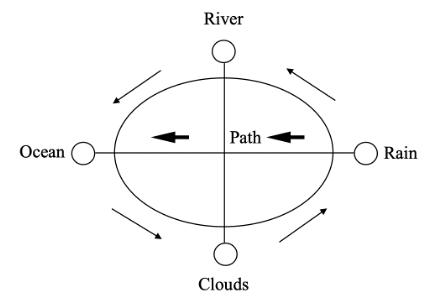
In this diagram the river is represented by the vertical axis and the path by the horizontal axis. The intersection of the axes might be thought of as representing what can be shared in words. The ellipse represents the actual water cycle that describes the true identity, home, and purpose of the river.
Such community ecologies might be thought of as indigenous theologies. They seem to describe how God (or the One behind the world) works, based on observation—as opposed to descriptions based on passages and books of scripture that can only be read by the literate.
But might there be another literacy, a nature literacy that might be just as foreign to the book-literate person as book literacy might seem at first to the nature-literate person? After all, who—other than the Creator—inscribes the river in creation to be continuously interpreted and reinterpreted by the creation—in forms such as the Akan proverb?
I encountered the Akan proverb as a translation into English from drum speech in a tonal language. Cognitive neuroscientist Aniruddh Patel explains the workings of “tone languages” that facilitated drum speech. In such languages,
pitch is as much a part of a word’s identity as are the vowels and consonants, so that changing pitch can completely change the meaning of the word….Tone languages may seem exotic to a speaker of a European language, but in fact over half of the world’s languages are tonal, including the majority of languages in Africa and southeast Asia.
In addition to being in a language that might seem “exotic,” the book for reading this scripture was a drum. In African community ecologies, wisdom from one generation was often passed to the next in ways that Western culture describes as musical.
According to music educator Samuel Floyd (1937-2016), African life and community were rife with ritual, which was preserved and nurtured through what we in the Western world know as art. In ritual, Africans expressed their worldview and symbolized intercourse between the material and spiritual worlds through Dance, Drum, and Song.
African drums were also used for communicating messages such as the proverb of the river and the path in a way that seems intimately connected to the ecology of human communities as well. Like more than half of the world’s languages and most of the languages in African and southeast Asia, the Akan language is tonal. So each syllable must be “sung” at the correct pitch to convey the correct meaning of each word.
The Akan and other West African tonal-language speakers developed an ecologically based fluency that enabled sending and receipt of messages over miles using what we now call “talking drums.” Talking drums were constructed and played to produce the different tones of a language in the same cadences and rhythms that people spoke.
Ordinary people miles away could also hear and understand the drummers’ messages as if they were spoken over a cell phone. In order to send and receive such messages, devoid of the consonant sounds of verbal speech, drummers and listeners needed to share a sensitivity to poetic improvisation grounded in the social and environmental ecologies of their shared human community.
Amiri Baraka (Leroi Jones; 1934-2014) made an African American connection:
The reason for the remarkable development of the rhythmic qualities of African music can certainly be traced to the fact that Africans also used drums for communication; and not, as was once thought, merely by using the drums in a kind of primitive Morse code, but by the phonetic reproduction of the words themselves—the result being that Africans developed an extremely fine and extremely complex rhythmic sense, as well as becoming unusually responsive to timbral subtleties. Also, the elaborately developed harmonic system used in the playing of percussion instruments, i.e., timbres to produce harmonic contrasts, was not immediately recognizable to Westerners used to less subtle musical devices.
Melodic diversity in African music came not only in the actual arrangements of notes (in terms of Western transcription) but in the singer’s vocal interpretation. The 'tense, slightly hoarse-sounding vocal techniques' of the work songs and the blues stem directly from West African musical tradition. (This kind of singing voice is also common to much other non-Western music.) In African languages the meaning of a word can be changed simply by altering the pitch of the word, or changing its stress—basically the way one can change the word yeh from simple response to stern challenge simply by moving the tongue slightly.
Philologists call this ‘significant tone,’ the ‘combination of pitch and timbre’ used to produce changes of meaning in words. This was basic to the speech and music of West Africans, and was definitely passed on to the Negroes of the New World.
The point here is that differentials of power have often brought cultures together during the modern era, and probably before then also. Perhaps now it is time for common humility to bring cultures together instead of (or perhaps in addition to) power differences. For until that happens the much needed growth in understanding that stands to enrich all cultures will not happen either.
For instance, the most powerful and most technologically literate culture on the globe today is also ecologically immature to a degree that threatens human survival globally. The recently inundated lands of northern Nepal—literally thousands dead and missing, tens of thousands affected—is a brutally striking case in point, a sombre continuation of global warming tragedies.
This is not due to lack of a theology, but due to a prideful inability to place that theology into an appropriate context of human community ecology. This is also not due to a lack of literacy, but due to a lack of interpretive maturity—an inability to see the broader picture that a nature literacy might add to a book literacy.
For example, a death followed by a resurrection is wondrous indeed, but it is also the ecology of rivers and of human communities—that is when human path builders have not totally interrupted the natural community ecology.
So, as with the seven directions prayer three weeks ago, to me the river ecology is a sun dance also, because the sun pumps the river ecology cycle by evaporating water into clouds. Now this is not dancing to “music,” which is a modern culture word that didn’t exist in most ancient languages. The dance is instead to ring-shout drum, dance and song.
The difference is key. People naturally made sounds and movements as part of each different ritual or activity: a wedding, a funeral, worship, reflection, work, and play. This is where the Negro spirituals came from. The idea of a “music industry” would not have made sense.
The movement of the sun leads one in a dancing, drumming and singing metaphor for the One who is beyond words or imagery. This for me is the magic of all religions, of all peoples. It is why I like the seven directions prayer so much. You turn to the seven directions, and in the ring-shouting dance, you are also in the seven directions.
As in Howard Thurman’s interpretation of the spiritual Wade in the Water: “at the heart of life there is a Heart.” Or as in Thurman’s search for common ground, there is an ever expanding community: the ring shout, the spirituals, Black music, American music and world music… but that’s another sermon.
May we individually and collectively know and become the divinely healing wholeness, the sacred and secular oneness of each and all directions, of all space and time throughout a sacred and secular cosmos of peace and blessings—in which we continually seek and grow in knowledge and wisdom of ourselves and of each other. May we wade in the waters of healthy ecologies.
Let us pray for the people of northern Nepal and throughout the world who are already feeling the effects of this unhealthy ecology. May we see this, awaken to what is happening, and set a new course for healthy global ecologies. Amen, Ameen, Ashay, and Let it be.
Comments